

Article
What does a Racking Installer actually do?
August 28, 2026
What does a Racking Installer actually do?
If you have never worked on a warehouse installation site, it can be difficult to picture what the job involves.
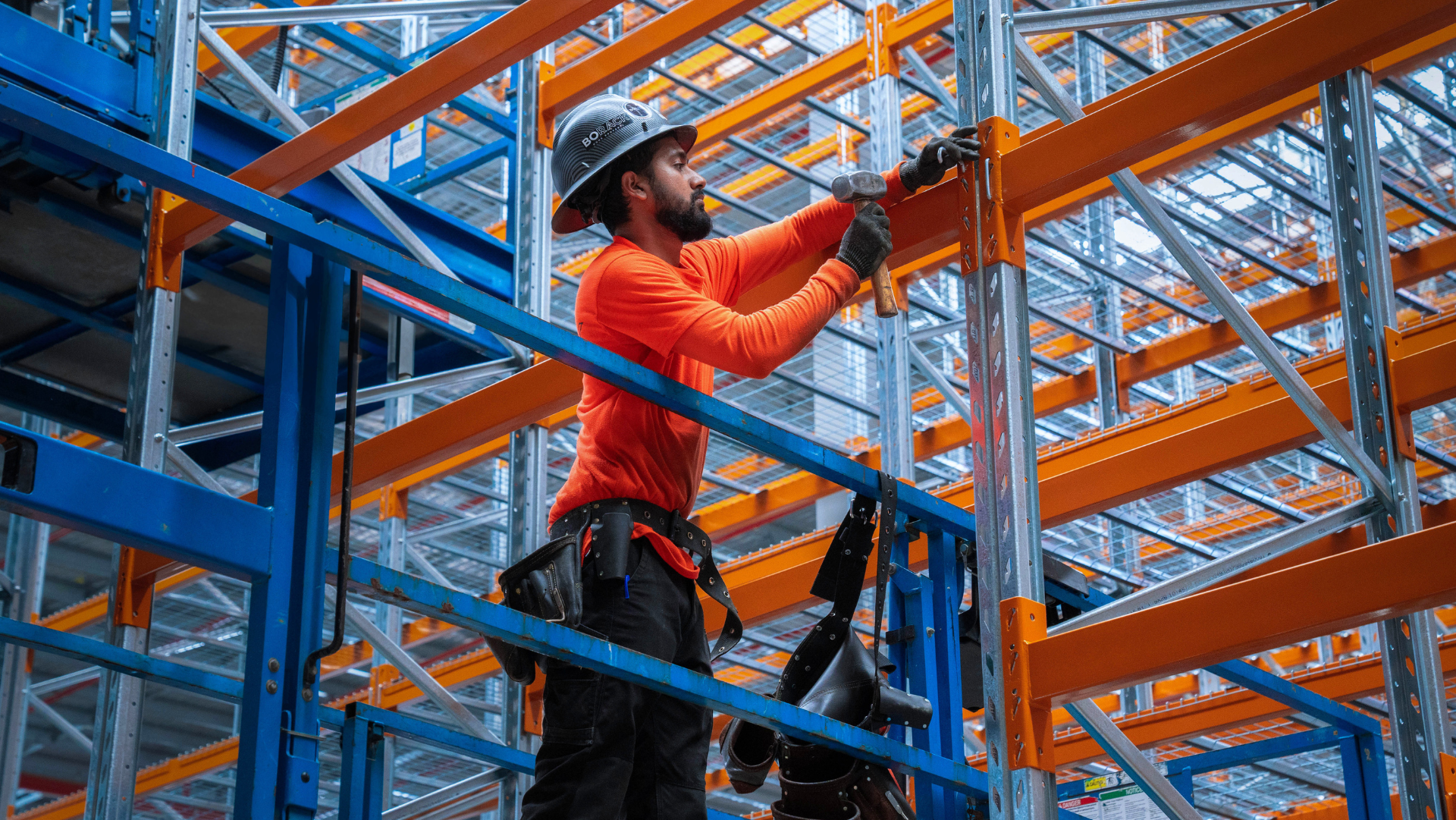
A Racking Installer works as part of a team to build, position and secure warehouse storage systems. The role includes reading technical drawings, assembling frames, installing beams, levelling and anchoring the system, and using tools and access equipment. It is active, physical work that requires accuracy, communication and close attention to safety.
What happens during a racking installation?
A project moves through several stages. You will not necessarily complete every stage in one shift — your tasks depend on where the project is up to, your role within the Field Crew and the tickets you hold.
1. Frame building
Frame building is where the main vertical structures of the racking system come together. The installer has to review the technical drawings, lay out the uprights, braces and baseplates, and check that the correct components are available and undamaged. Once assembled, the frames are positioned so they are ready for the next stage.
2. Frame standing
Frame standing is the process of raising the assembled frames and positioning them in their final location. This creates the main structure — or skeleton — of the racking system.
At BORACK, this is a coordinated task. A forklift operator lifts and supports the frame, another team member (the runner) guides it into position, and a trained scissor lift operator helps secure it with the top beams.
3. Beaming
Beaming connects the upright frames and creates the levels that will eventually support pallets. The beams are fitted into the uprights at the heights shown on the plans and secured with safety clips.
4. Levelling and alignment
Warehouse floors are not always completely even, so the frames need to be checked and adjusted. Installers use spirit levels and steel levelling plates beneath the baseplates to bring the racking within the required tolerances. String lines or laser alignment may also be used to check that the rows are correctly positioned.
5. Drilling
Once the racking is aligned, installers use powerful drills with integrated dust extraction to drill into the concrete through the baseplates. The extraction system helps capture dust and keep the work area controlled during drilling.
6. Anchoring
After the holes have been drilled and vacuumed, the installers insert the specified anchor bolts. The anchors are then tightened to the manufacturer's torque requirements using the appropriate tools.
7. Operating a scissor lift
Scissor lifts allow trained Racking Installers to complete tasks at height, including fitting beams, securing safety clips and making adjustments.
Only team members with the appropriate training, competency and site authorisation can operate a scissor lift.
8. Operating a forklift
This is different from moving standard pallets around an established warehouse. The operator may need to handle long materials in a work area shared with installers, access equipment and partly completed racking.
Only licensed and authorised team members can operate a forklift.
Does every project follow the same routine?
The main installation stages are consistent, but the daily routine changes depending on the storage system, warehouse and project plan.
Some days focus on building frames. Others may involve beaming, drilling, anchoring or moving materials. BORACK also installs and dismantles different systems, including selective racking, cantilever racking, mezzanine floors and safety accessories.
What tools and equipment do Racking Installers use?
The tools depend on the task. A typical project may involve tape measures, string lines, laser alignment tools, spirit levels, spanners, sockets, impact drivers, concrete drills, dust extraction equipment and torque tools.
The crew may also use forklifts and scissor lifts to move materials and reach elevated work areas.
How physical is racking installation?
Racking installation is active work. You may spend much of the shift standing, walking, bending, reaching and handling components.
You do not need to be the strongest person on site, but you should be comfortable with physical work and able to follow safe handling methods throughout the shift.
What should a new Racking Installer expect?
At Level 1, you usually begin with the fundamentals. This may include preparing components, helping build frames, organising materials, keeping the work area clear and learning how to use basic tools correctly.
You will also need to learn component names, site procedures and how to follow technical drawings. A Leading Hand or Site Supervisor will explain your tasks and check your work as you develop.
Skills can be taught. What matters to us is your attitude — being reliable, listening carefully, asking when you are unsure and working safely as part of the Field Crew.
As you progress, BORACK will help you arrange the tickets required for scissor lift and forklift operation. T&Cs apply.
Read more: How do I get a scissor lift ticket in Australia?
Read more: How do I get a forklift ticket in Australia?
Ready to see if the role suits you?
If you want practical work, a crew that will teach you properly and a role you can build a career out of, apply for a Racking Installer role with BORACK.
Apply Now

SIGN UP
A concise overview of our availability per state.
